|
|
||||||
|
|
||||||
|
|
||||||
|
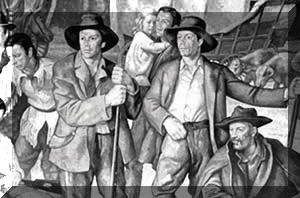
Each Spring, thousands of wagon trains left for California, and the story of the Arkansas Emigrants and the Mountain Meadows Massacre, has incorrectly morphed into one large, all-inclusive, "Baker-Fancher" Train whose members all departed from Bellers Stand/Milum Springs, in Carroll County, Arkansas at the same time. No such train ever existed. The Baker Train did depart from Bellers Stand/Milum Springs, in Carroll County, near present day Harrison. However, the Fancher Train left from Benton County, Arkansas. The Huff Train also left from Benton County. The Poteet Train, the Tackitt Train, and the Jones Train (all relatives) originally departed from Johnson County and traveled up through Washington County. (The Poteet Train survived the Massacre.) The Cameron Train and the Miller Train (previously from the Osage area) also left from Johnson County, while the Mitchell Train, the Dunlap Train and the Prewitt Train departed from Marion County. These trains all departed at different times and were under the organization of each individual wagon train master. There were many other wagon trains that joined up along the way, broke off, or joined up again during their journey westward from Arkansas. Those other wagon trains included the Georges Creek Train, the Campbell Train, the Parker Train, and others who remain unknown. (These known trains escaped the Massacre.) The Fancher Train arrived in Salt Lake a week or more before the others who would join up and travel south together through Utah, while the Baker Train was the last to arrive in Salt Lake. It was at Salt Lake, in the Utah territory, not Carroll County, Arkansas, that these individual wagon trains ultimately joined together to form the large group that would travel south together through Utah towards Mountain Meadows. There were probably individuals and elements of other wagon trains that joined this group in Salt Lake, as was the custom at that time. Because of this, it will never be known with certainty the names of all of those who were members of the trains on the fateful day they reached Mountain Meadows, in the Utah Territory.
(From the upcoming book "1857: An
Arkansas Family Primer To The Mountain Meadows Massacre", by
Lynn-Marie Fancher and Alison C. Wallner. Copyright 2010.
Re-printed here with the permission of the authors.) |
||||||
|
|
||||||
|
© 1998-2014 Mountain Meadows Association. All rights reserved. |
||||||